Visible today
A living welcome to Eagleworks
The tangible commercial offer: a standard red Farmwall, indicative fresh microgreen supply and agreed professional service. Valuable even without a future research program.
Proposed Eagleworks collaboration
FARMWALL × LA TROBE UNIVERSITY EAGLEWORKS · PROPOSED 2026 COLLABORATION
A living platform for the next generation of food innovators.
What if the greenery welcoming visitors to Eagleworks could also grow fresh food, reveal the science of living systems and inspire new ideas? Farmwall proposes a living installation at the entrance to Eagleworks—bringing together an immediate need for greenery with opportunities for food literacy, youth engagement and future innovation.
Private partnership proposal · exploratory concept
Approximately 30 microgreen cups each week
FROM CURIOSITY TO IMPACT
01 / The Idea
Indoor plants can transform how a space feels. Farmwall builds on that value by making food production visible and giving people something to discover, discuss and learn from.
Conventional indoor plants remain valuable and can complement the entrance Farmwall. This proposal does not claim to replace all planting needs or establish health, productivity, cost or environmental superiority.
Visible today
The tangible commercial offer: a standard red Farmwall, indicative fresh microgreen supply and agreed professional service. Valuable even without a future research program.
Learning potential
Visible biology and food production could support learning. Living Food Lab and Fuel Your Focus extend that invitation; facilitated activities require separate scope.
Innovation potential
Youth Food Lab and interested university capabilities could open future pathways. No participation, funding or research commitment is assumed.
02 / The Installation
Positioned near the entrance, a Farmwall could create a distinctive first impression: living plants, fresh microgreens and a visible food-growing system that invites curiosity.
Final placement depends on floor area, circulation, accessibility, safety, electrical requirements, service access, operating conditions and site approval. The supplied office approach photograph is not verified as the entrance; no installation composite has been fabricated.
The AUD $14,000 annual subscription covers the agreed standard Farmwall service package, including routine system care and agreed maintenance. Farmwall retains equipment ownership. Approximately 30 cups of microgreens weekly is indicative supply, not a count of individual servings.
Detailed service inclusions and site-specific requirements will be confirmed in the final agreement. Optional planting purchases, workshops, research, window decals and pegboards are not included.
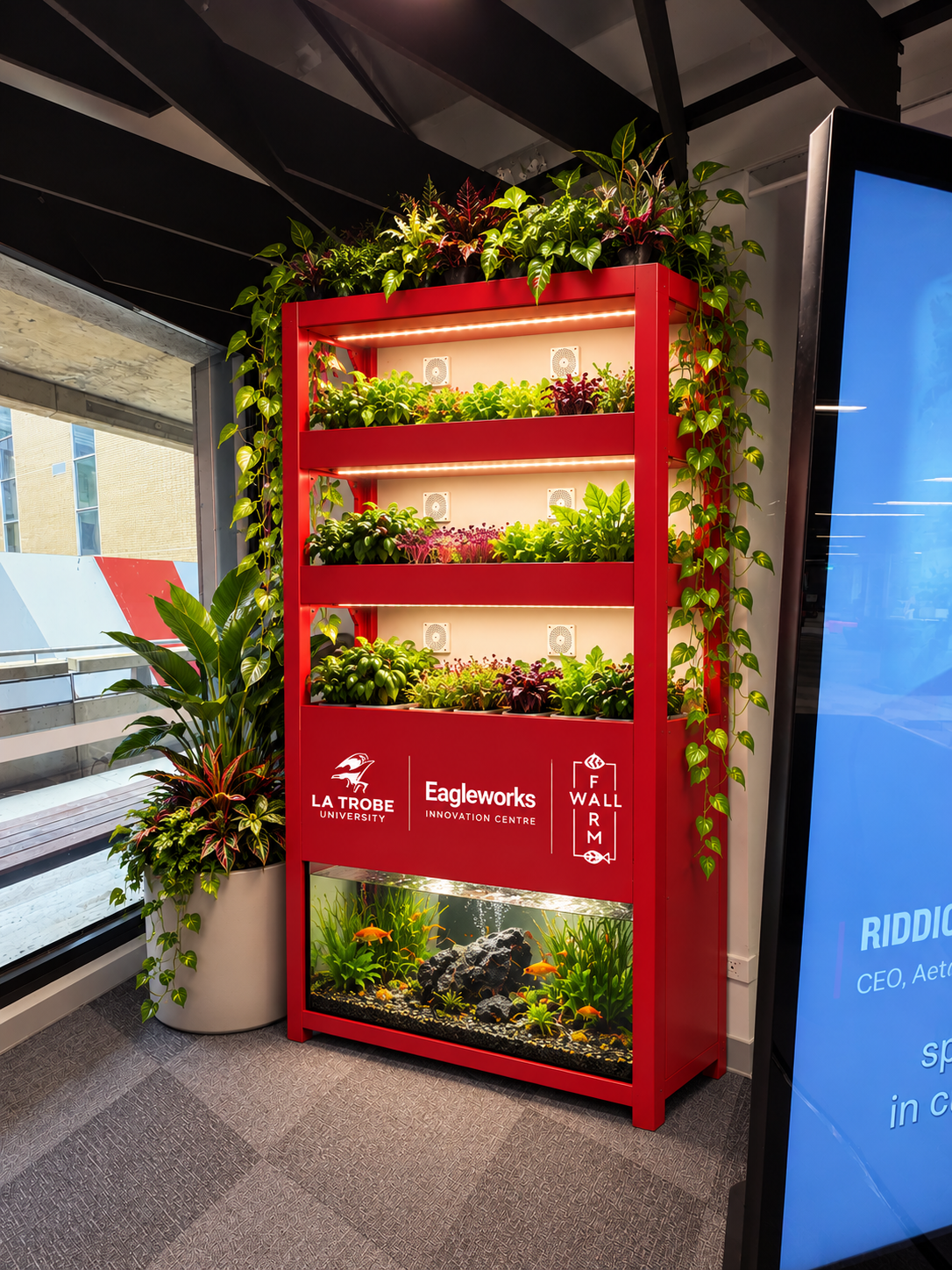
Three illuminated growing tiers sit above a visible aquarium. The supplied image is the design reference: red frame, lighting, proportions, growing tiers and lower aquarium must be retained. Positioning must allow safe circulation, access for servicing and an unobstructed view of the system.
Supplied authentic Farmwall photograph. Proposed Eagleworks installation; final placement and visible branding require approval.
Fish waste introduces ammonia into water. Beneficial nitrifying bacteria convert ammonia to nitrite and then nitrate. Plants can absorb available nutrients; filtration and recirculation support the configured system. Fish health depends on actively maintained water conditions, including oxygen and pH.
The photograph does not reveal internal plumbing or filtration. Farmwall must confirm the crop-growing method and nutrient supply; the proposal does not assume all microgreen tiers receive fish-derived nutrients.
The proposed service includes growing and supplying approximately 30 cups of microgreens weekly. An agreed Eagleworks sharing arrangement could connect the harvest to everyday meals and optional learning activities. Crop choice, handling and actual operating periods would be agreed with Farmwall.
Cups are a supply unit, not a count of individual servings. The Fuel Your Focus calculator illustrates 40 operating weeks × 30 cups = 1,200 cups; it is not an achieved annual outcome.
Farmwall provides routine aquaponic servicing, fish-health and water checks, lighting checks, replanting and harvesting. Routine care also covers the agreed indoor plant inventory. Site access and any host responsibilities would be settled in the service agreement.
Major plant replacements are excluded unless separately agreed. Farmwall retains ownership of the Farmwall unit. Purchased indoor plants and pots belong to La Trobe.
An indicative AUD $3,500 one-time allowance establishes approximately 20 plants and pots across agreed spaces, including materials, delivery and placement. Architectural foliage, smaller table plants and restrained trailing greenery can be selected according to available light and use of each space.
Final species, quantities and pot sizes require assessment. Doorways, emergency equipment, accessible circulation, appliance ventilation and maintenance access must remain clear.
The supplied photographs identify event and collaboration seating, a kitchenette, the digital display and a glass-office approach. Four planting studies add a small number of plants to those actual views, rather than inventing new interiors.
Optional indoor planting can extend greenery beyond the Farmwall entrance feature. Choose an alternative allowance against a final plant and pot schedule; La Trobe owns the purchased plants and pots.
A transparent, perforated decal could bring aquaponics, microbial nutrient cycling, microgreens and youth innovation into a layered learning exhibit. Strategic unprinted areas would preserve views and light. Its interactive web counterpart can hold deeper explanations than the physical artwork.
The decal is optional and separately priced. A suitable straight-on glass photograph, measured dimensions, material specification and print proof are needed before a site-specific installation design.
A separate pegboard display could organise living plants, small shelves and interchangeable learning material around plants, food systems, aquaponics and innovation. It can be considered independently from the decal.
Wall suitability, fixing methods, loading, access, educational content and approved branding require review. The pegboard is not included in the subscription or plant establishment allowance.
Included service
Standard red Farmwall, approximately 30 microgreen cups weekly, routine system and agreed indoor-plant care.
Separately scoped
Purchased plant establishment; optional decal, pegboard, workshops, research initiatives and technology integrations. These require their own scope; the plant allowance is listed separately in the offer.
Relevant education and community project examples will be added once their scope, authentic photographs and permissions are confirmed. No institution is presented here as a verified client or endorser without supporting evidence.
Beyond the Farmwall entrance feature, thoughtfully selected indoor plants could bring additional greenery throughout Eagleworks. Explore how the existing spaces might look with a complementary planting scheme.
Existing Eagleworks photographs. Planting visualisations await approval; final species, quantities and positions are subject to the agreed schedule and site assessment.
AUD $3,500
Approximately 20 plants and pots, subject to final selection and site assessment.
AUD $5,000
Expanded planting selection. Final quantity to be confirmed against the chosen plant and pot schedule.
Alternative purchases, not cumulative packages. Plants and pots are separate from the annual Farmwall subscription. Visual studies do not specify the final plant count or species.
Optional educational element
Editable concept for review only. Optional and separately quoted; not print-ready. Dimensions, material, perforation, viewing distance and print proof remain to be confirmed.
Optional timber education wall
A separate pegboard display could organise living plants, small shelves and interchangeable learning material around plants, food systems, aquaponics and innovation. It can be considered independently from the decal.
Wall suitability, fixing methods, loading, access, educational content and approved branding require review. The pegboard is not included in the subscription or plant establishment allowance.
03 / Learning
Five connected stages give a visible growing system educational depth. They start with careful observation, distinguish evidence from assumptions and lead to practical outputs that can be reviewed. These are proposed learning briefs, not approved courses or research activities.
Explore the Living Food LabFROM CURIOSITY TO IMPACT
01 / OBSERVE
FROM CURIOSITY TO IMPACT
Start with the visible elements: microgreens under lighting, the aquarium, plant roots where safely visible and the movement of water in the confirmed configuration. Notice changes rather than making immediate judgements about health, efficiency or crop nutrition.
The conceptual observation guide below identifies areas to explore. Compare it with the supplied Farmwall image on the separate review page; neither confirms an installed Eagleworks system. Internal filtration, plumbing and nutrient pathways cannot be verified from the photograph.
Above each growing tier
Lighting supports photosynthesis. Compare the visible crop response over time rather than assuming brightness proves efficient growth.
02 / QUESTION
FROM CURIOSITY TO IMPACT
Fish metabolism and decomposing organic matter introduce ammonia and ammonium. Their balance depends on pH and temperature. In a suitably maintained biological filter, ammonia-oxidising microbes produce nitrite and nitrite-oxidising microbes produce nitrate, a plant-available form of nitrogen.
Nitrification requires oxygen and suitable conditions. Ammonia and nitrite can harm fish, and nitrate uptake does not remove every dissolved substance. Water quality, system balance and crop nutrition need active care; recirculation is not complete purification.
A biological pathway, sustained by active care
Waste introduces ammonia and ammonium. pH and temperature affect their balance; ammonia can be toxic to fish. This input must be managed, not celebrated as automatically beneficial.
Oxygen, appropriate pH, temperature and established microbial communities support nitrification. Arrows describe a biological process, not the confirmed pipe layout or nutrient supply of every Farmwall crop.
FAO · Small-scale aquaponic food production03 / INVESTIGATE
FROM CURIOSITY TO IMPACT
Temperature, pH, dissolved oxygen, light, crop height and agreed water-quality observations could describe how a growing system behaves over time. Electrical conductivity may be relevant in some configurations, but it is not a direct reading of individual nutrients or crop nutritional value.
A future pilot should specify the question, measurement method, calibration, observation period, safe access, data ownership and limitations. Sensor installation, dashboards and AI-assisted analysis are future possibilities, not features confirmed in this installation. A correlation in a small observation log is not proof of causation.
A possible recording plan
What the data cannot establish
An observational comparison cannot isolate every growth factor or establish nutrient composition.
04 / COLLABORATE
FROM CURIOSITY TO IMPACT
Different questions call for different expertise. Plant-growth observations might connect to AgriBio or LISAF; food-quality questions to the Centre for Food Science within LISAF; monitoring prototypes to the Digital Innovation Hub and Innovation Central Melbourne. Bio Innovation Hub and Eagleworks / Ignite offer different innovation contexts.
An introduction is not a partnership. A feasible collaboration needs a willing partner, a scoped learning or research question, staff capacity, supervision, safety review, permissions and an agreed output. Youth Food Lab’s proposed champion role could connect the learning stages without implying it controls university activity.
Match a possible collaborator
Indoor controlled-environment demonstrations, crop comparisons, sensors, resource-use monitoring, food and nutrition education, student learning and research translation.
05 / APPLY
FROM CURIOSITY TO IMPACT
Application can be modest and concrete: a food-literacy workshop outline, an inclusive microgreen-sharing plan, a clear nitrogen-cycle display or a monitoring prototype proposal. The value lies in solving an identified need and testing assumptions, rather than promising a scalable breakthrough.
Australia-Pacific Youth Food Lab could champion four proposed innovation challenges. Any tasting, system interaction, data collection or prototype trial needs the relevant hygiene, supervision and approval arrangements. Outputs should state what was learned and what remains to be tested.
04 / Australia-Pacific Youth Food Lab
Australia-Pacific Youth Food Lab is proposed as the overarching champion of the Farmwall × Eagleworks Living Innovation Platform: a connecting thread between a cared-for demonstration, food literacy, university expertise and youth-led ideas.
The model starts with distinct responsibilities. Farmwall supplies and services the growing demonstration. Eagleworks could provide the setting and community connections. Interested La Trobe researchers and programs could contribute expertise within agreed scope. Youth Food Lab could champion engagement and progression through Grow, Learn, Investigate and Innovate. None of these educational roles is formally agreed.
01 / Grow
02 / Learn
03 / Investigate
04 / Innovate
Proposed streams only. Participation, safeguarding, supervision, intellectual property, approvals and any budget would be agreed before activity begins. Funding is not secured and is not a condition of the core Farmwall subscription.
05 / The Ecosystem
Proposed flagship champion · subject to partner agreement
A proposed champion of the entire initiative — connecting youth leadership with all seven research and innovation opportunities through the living Farmwall platform.
Seven primary research & innovation opportunities
Exploratory opportunity · 01 / 07
LISAF’s six research priorities
Protected cropping and next-gen crops offer contexts for discussing controlled-environment plant growth; farming systems and digital agriculture for responsible resource and sensing questions; food for nutrition and health for food-quality literacy; agri-food business and policy for service and access questions. A small demonstration does not address all six domains or establish a research partnership.
Two possible collaborative activities
Explore a supervised learning brief comparing agreed crop characteristics and resource-use observations.
Potential output: An observation protocol, growth log and descriptive comparison poster; not a validated agricultural trial.
Relate controlled-environment growing, food literacy or a sensing question to the relevant LISAF domains.
Potential output: A prioritised opportunity map and a scoped learning or research brief.
Before proceeding
Exploratory only — subject to partner interest, scope, resources and approval.
Seven opportunity profiles, not seven independent institutions: Centre for Food Science is part of LISAF, Innovation Central Melbourne sits within the Digital Innovation Hub, and Ignite is an offering associated with Eagleworks.
All connections shown are proposed opportunities, not confirmed partnerships. Champion roles and projects are subject to partner agreement.
06 / 2026 Activation
Begin partnership discussions and site planning in 2026, with installation and activation subject to agreed timing. This is a purchasing pathway, not a guaranteed full-year program.
Confirm interest, decision-makers, objectives and the purchasing pathway.
Review the entrance location, safety, access, utilities and servicing requirements.
Confirm the annual subscription, chosen optional planting allowance and any separately scoped elements.
Schedule and complete the agreed installation after approvals and site requirements are satisfied.
Introduce the system and consider separately agreed learning or innovation activity.
These are proposed review measures, not achieved results or guaranteed milestones. The subscription is independent of optional research, youth programming and funding.
07 / Partnership & Funding
A credible partnership starts by separating the contracted service from the educational ambition. The commercial proposal sets out the Farmwall service and plant establishment; research, youth programming, displays and digital work would be scoped and agreed independently.
Farmwall annual subscription
AUD $269 / week
Rounded weekly equivalent of AUD $14,000. Billed annually upfront. Weekly payment is not offered.
The AUD $14,000 annual subscription covers the agreed standard Farmwall service package, including routine system care and agreed maintenance. Farmwall retains equipment ownership. Approximately 30 cups of microgreens weekly is indicative supply, not a count of individual servings.
Detailed service inclusions and site-specific requirements will be confirmed in the final agreement. Optional planting purchases, workshops, research, window decals and pegboards are not included.
Essential Greenery
AUD $3,500
Approximately 20 plants and pots, subject to final selection and site assessment.
Expanded Greenery
AUD $5,000
Expanded planting selection. Final quantity to be confirmed against the chosen plant and pot schedule.
Choose one option; allowances are not cumulative. All prices in AUD; GST treatment to be confirmed. Final species, quantities and installation requirements are subject to schedule and site assessment.
Anne could explore youth innovation, food education, industry collaboration, research partnerships, sponsorship or philanthropy after defining a feasible pilot and interested partners. These are categories to investigate, not available grants or a claim of eligibility. A fundable brief would need a need, responsible method, tangible outputs, realistic costs, partner commitments and a proportionate evaluation plan.
No funding is available, approved or guaranteed by this proposal. Funding exploration is optional future expansion, never a condition of installation or annual subscription.
Start with a living installation that answers an immediate need for greenery—and creates opportunities for learning and innovation as the partnership develops.
A verified Farmwall contact destination is still needed before purchase discussions can be initiated here. No payment or binding acceptance is taken on this website.