THE LIVING FOOD LAB

Where biology, food, technology and youth innovation meet.

A living food system is more than what grows above the water. Follow the relationships between fish, microbial communities, nutrient cycling and plant growth, then turn an observation into a question worth investigating.

010203LightingPlant-available nutrientsRoot zoneBiological filtration · conceptual insetFish aquariumNH₃ → NO₂⁻ → NO₃⁻

What do fish contribute to the cycle?

Fish metabolism releases nitrogenous waste. Uneaten feed and other organic matter can also contribute as they break down. Ammonia and nitrite may harm fish, so oxygen, water chemistry and routine professional care matter as much as the visible aquarium.

Observe fish behaviour from outside the tank and record a question for Farmwall. Do not feed fish, add substances or alter equipment without guidance.

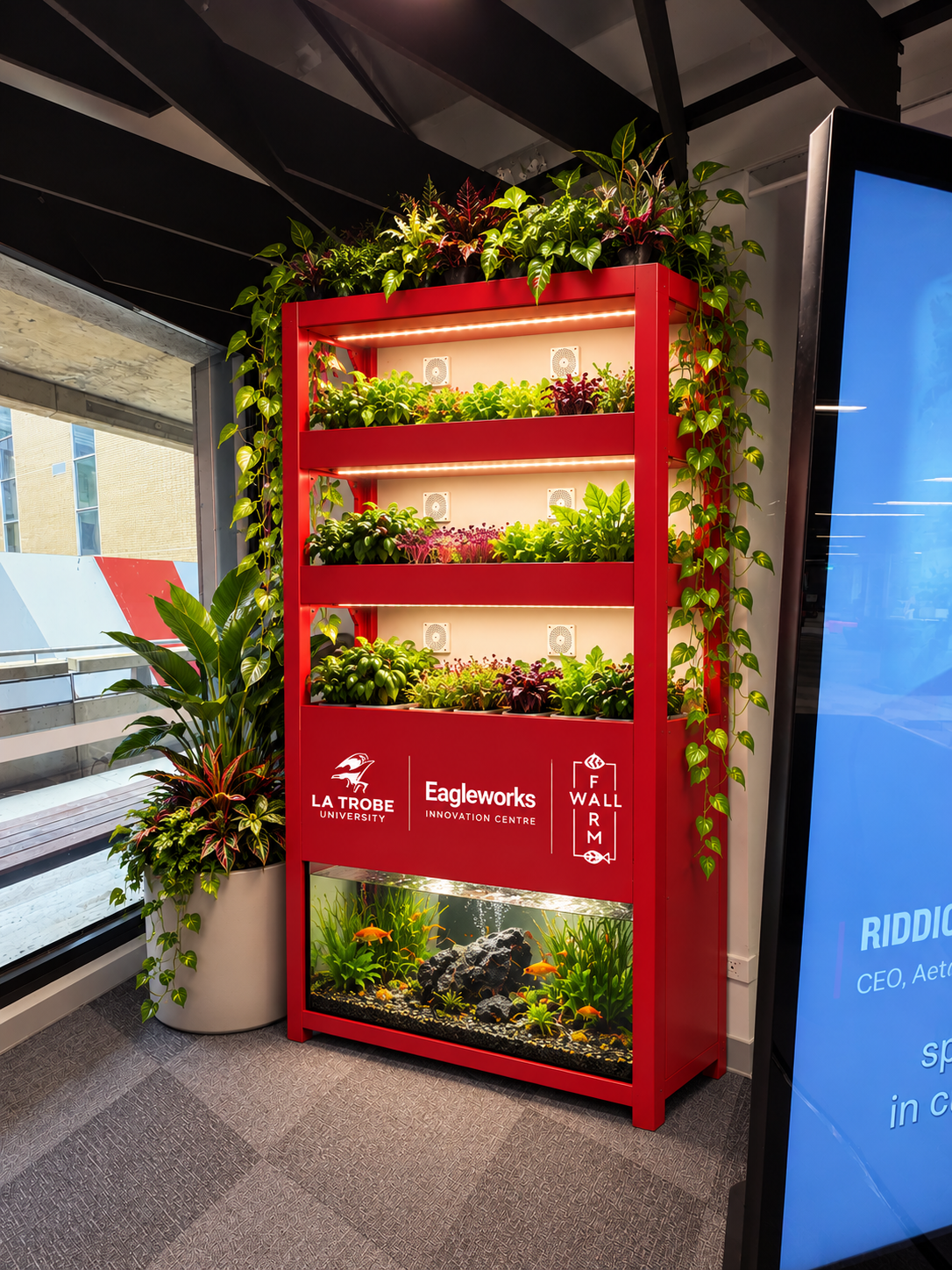
Supplied equipment reference · unchangedSupplied red Farmwall image, preserved in full with three growing tiers, aquarium, branding and original background

Supplied image, unchanged. Its use does not confirm an installed Eagleworks system or approval of visible branding.

Equipment proportions follow the supplied red Farmwall reference. The biological filtration inset and arrows are conceptual learning layers, not verified hardware, internal plumbing or a technical cutaway. Crop configuration and fish-derived nutrient supply to the microgreen tiers require Farmwall confirmation.

Invisible work. Visible growth.

Waste introduces ammonia and ammonium. pH and temperature affect their balance; ammonia can be toxic to fish. This input must be managed, not celebrated as automatically beneficial.

Oxygen, appropriate pH, temperature and established microbial communities support nitrification. Arrows describe a biological process, not the confirmed pipe layout or nutrient supply of every Farmwall crop.

FAO · Small-scale aquaponic food production

Observe. Question. Investigate. Collaborate. Apply.

What is visible, and what is still unknown?

Explore the five system hotspots, then make a dated observation sheet. Separate directly visible features from conceptual biology and unverified equipment configuration.

Tangible learning output: An observation sheet and three questions for Farmwall.

Explore this activity

What keeps the whole system in balance?

Fish, microbes and plants have different needs. Fish introduce nitrogenous waste; microbial communities transform some of it; roots can take up dissolved nutrients. These relationships depend on suitable water conditions and active servicing, not simply the presence of plants and an aquarium.

Biological filtration provides surfaces and conditions for microbial activity. Physical solids management and water chemistry still matter. In the illustrated model, the microbial inset is a teaching device: it does not identify hidden equipment in the supplied photograph.

Make a dependency map: fish need appropriate water and oxygen; nitrifying microbes need established surfaces and suitable conditions; crops need light, water and nutrients. Mark which relationships require confirmation for this installation.
Potential AgriBio or LISAF plant-science guidance; Bio Innovation Hub expertise could inform a non-laboratory safety-boundary discussion. Farmwall is not PC2-certified by this proposal.
An annotated system map and three operational questions for Farmwall.

Waste introduces ammonia and ammonium. pH and temperature affect their balance; ammonia can be toxic to fish. This input must be managed, not celebrated as automatically beneficial.

Oxygen, appropriate pH, temperature and established microbial communities support nitrification. Arrows describe a biological process, not the confirmed pipe layout or nutrient supply of every Farmwall crop.

FAO · Small-scale aquaponic food production

How do we move from a seed to a responsible harvest?

An agreed microgreen crop moves through sowing, germination, growth under appropriate lighting and harvest. Crop selection affects timing, flavour and growing requirements. Farmwall’s crop configuration and care guidance determine the method; no exact cultivation recipe is assumed here.

The commercial proposal includes approximately 30 cups weekly, not 30 individual servings. Food handling, hygiene and distribution require an agreed arrangement. Species, cultivar and conditions influence composition; growing a crop does not establish a health or cognitive benefit.

Create a growing journal for one approved crop, recording visible stage, date and the operator’s harvest guidance. Add a food-handling question before proposing a sharing activity.
Possible LISAF protected-cropping and AgriBio learning links; Centre for Food Science within LISAF for appropriately scoped food-quality or food-literacy questions.
A dated crop journal and a proposed harvest-sharing checklist.

Which crop suits the question?

Choose a crop with Farmwall guidance. Consider growing requirements, harvest timing and the intended learning activity, not unsupported nutritional rankings.

Which measurement would make your question clearer?

Potential readings include temperature, pH, dissolved oxygen, light and plant-growth observations. Each measurement needs a defined method, units, timing and limitations. Instruments require calibration; a single reading is not a diagnosis and an observational correlation is not proof of causation.

Sensors, dashboards and AI integrations are exploratory possibilities, not installed capabilities. A future pilot needs operator approval, appropriate supervision, safe access, costs and data governance. AI cannot replace validated measurements or Farmwall’s agreed care procedures.

Choose a measurement below and draft a recording plan: question, instrument, frequency, units, calibration checks, responsible person and what the result cannot establish.
Potential LISAF digital agriculture and Digital Innovation Hub input. Hardware, networks, dashboards and any student project require separate agreement.
A measurement brief with uncertainty notes, not fabricated live readings.
How does water acidity change across agreed observations?

pH scale
Use an approved, calibrated method and record time, calibration and operating context.
No target range or dosing advice is set here. Crop, fish and microbial requirements must be assessed by the operator.

What could young people make useful from what they learn?

Australia-Pacific Youth Food Lab is proposed as the flagship champion of an observation-to-application journey. Grow, Measure, Nourish and Innovate are possible challenge briefs that connect food production, evidence, access and practical design.

A tangible outcome can be small: a careful comparison plan, an inclusive food-literacy activity or a prototype brief with a clearly stated user need. Workshops, research and technology projects are separately scoped. No participating partner, funded program or achieved impact is implied.

Select one challenge, identify a user or learning need and propose a safe first test. Include approvals, resources and a modest evidence-based measure of learning.
Potential Youth Food Lab championing with interested Eagleworks, Farmwall and La Trobe educators or innovation partners, subject to agreement.
A youth challenge brief ready for discussion, with a feasible next step.

How can we grow food with fewer resources?

Map the inputs for one approved growing cycle and design a fair comparison that records crop, time, light and agreed water-use observations. Do not claim savings without a valid baseline.
Potential LISAF protected-cropping or farming-systems input; AgriBio plant-science expertise.
A resource-question map and comparison protocol with limitations.

A question is the beginning of a connection.

These capabilities offer relevant contexts to explore. No organisation has agreed to participate. Centre for Food Science is part of LISAF, and Bio Innovation Hub’s laboratory certification does not apply to Farmwall.

La Trobe Institute for Sustainable Agriculture and Food

La Trobe’s research and training institute for sustainable agriculture and nutritious food production, based at AgriBio.

Support basic and translational agri-food-health research and training through six interconnected research domains, addressing sustainable and nutritious food production in a resource- and climate-constrained world.

Indoor controlled-environment demonstrations, crop comparisons, sensors, resource-use monitoring, food and nutrition education, student learning and research translation.

Official reference
Explore the seven opportunity profiles

A proposed living demonstration. A thoughtful learning journey. A first step to discuss.